Article
WooCommerce and Shopify can both run strong ecommerce stores, but the better choice depends on ownership, flexibility, maintenance, budget, and growth plans.
Compare WooCommerce and Shopify across ownership, flexibility, cost, maintenance, SEO, design control, and long-term ecommerce growth.
WooCommerce vs Shopify: Which One Should You Choose for Your Store?
Choosing between WooCommerce and Shopify is not only a technical decision. It is a business decision. Both platforms can run successful ecommerce stores. Both can support products, payments, shipping, discounts, and customer orders. Both can work for small businesses, growing brands, and more serious ecommerce operations. But they are built with different ideas. Shopify is a hosted ecommerce platform. It gives you a managed system where hosting, core ecommerce features, checkout foundation, and platform updates are handled within Shopify’s ecosystem. WooCommerce is an ecommerce plugin for WordPress. It gives you more ownership and flexibility, but it also gives you more responsibility for hosting, maintenance, plugins, performance, and technical decisions. So the question is not simply, “Which one is better?” The better question is: Which platform fits your business model, your content strategy, your customization needs, and your long-term growth plan?
The Simple Difference
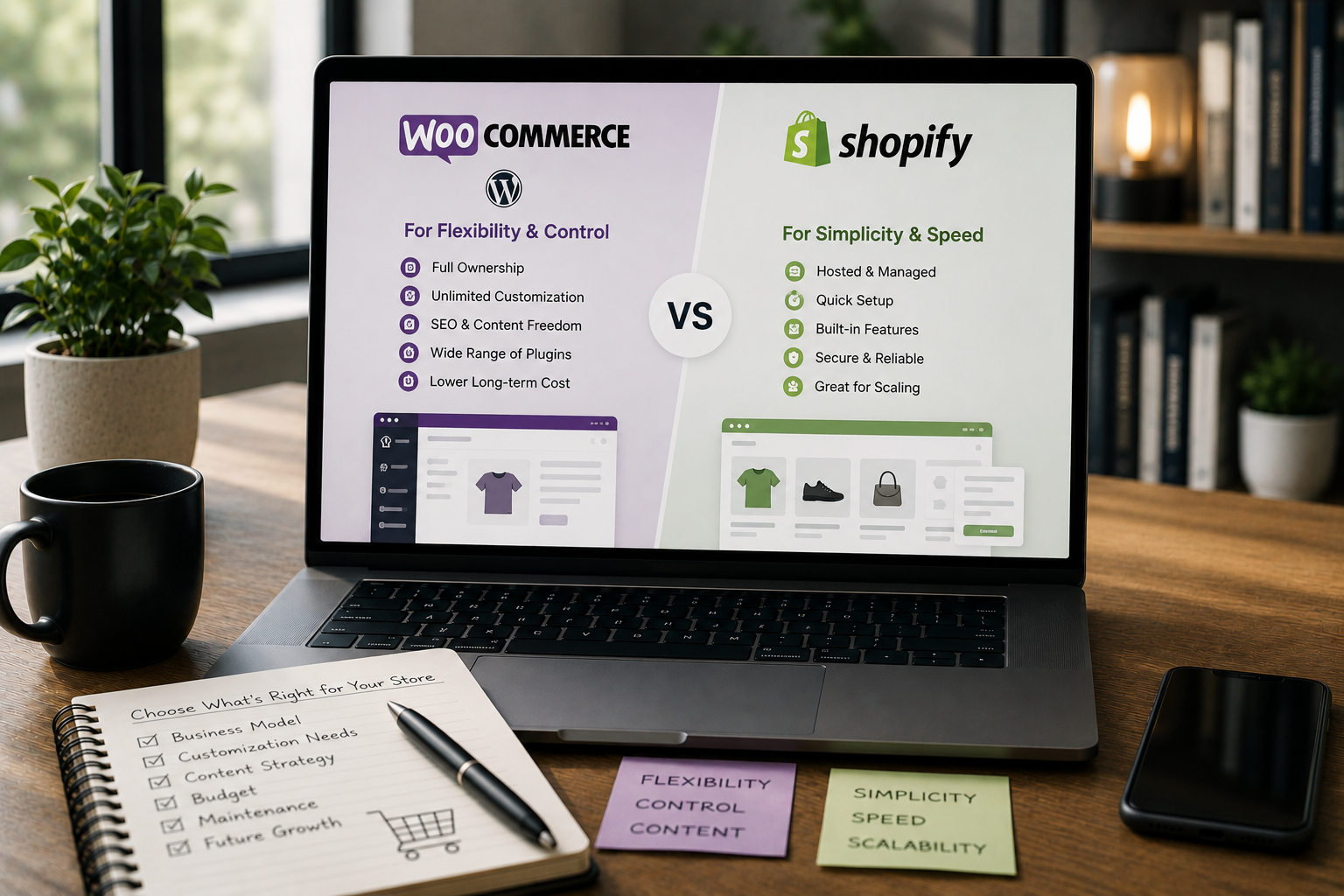
The easiest way to understand the difference is this: Shopify is more managed. WooCommerce is more flexible. Shopify is often attractive because it gives store owners a cleaner starting point. You can choose a theme, add products, connect payments, set shipping, and begin selling with less technical setup. WooCommerce is attractive because it sits inside WordPress. That means you can build a store around a content-rich website, custom design system, SEO strategy, service pages, landing pages, blogs, custom post types, and more advanced workflows. Neither approach is automatically better. The right answer depends on what your store needs now and what it may need later.
Ownership and Control
Ownership is one of the biggest differences between WooCommerce and Shopify. With WooCommerce, your store runs on WordPress and your own hosting environment. You control the website files, database, hosting setup, plugins, theme, and content structure. That gives you more freedom to customize how the store works. With Shopify, your store runs inside Shopify’s hosted platform. You own your brand, products, content, and customer data according to the platform’s rules and export options, but the core system is controlled by Shopify.
WooCommerce Gives More Control
WooCommerce can be a strong fit when you want control over:
- Hosting environment
- WordPress theme structure
- Checkout customization
- Product page layout
- Content and blog system
- Custom fields
- SEO structure
- Plugin choices
- Backend workflows
- Integrations
- Data handling This control matters when your ecommerce store is not just a basic product catalog. For example, a business may need product pages connected to guides, service content, case studies, comparison pages, lead capture forms, custom calculators, or special checkout logic. WooCommerce is often better suited for that kind of custom setup.
Shopify Gives More Platform Simplicity
Shopify gives less low-level control, but that can also be a benefit. For many store owners, managing hosting, plugin conflicts, security updates, and technical performance is not something they want to handle. Shopify removes many of those concerns by keeping the platform more controlled. That makes Shopify a good fit for businesses that want to focus on products, operations, and marketing instead of technical website management.
Flexibility and Customization
WooCommerce usually offers more flexibility because it is connected to the larger WordPress ecosystem. You can customize templates, create custom fields, build custom product layouts, add custom post types, modify checkout behavior, create custom dashboards, and connect with external tools. Shopify also supports customization, especially through themes, apps, and development work. But some parts of the platform are more controlled. You can customize a lot, but not always in the same open-ended way as WordPress and WooCommerce.
Choose WooCommerce When You Need Custom Workflows
WooCommerce may be better when your store needs:
- Custom checkout logic
- Special product configuration
- Complex product content
- Advanced SEO pages
- Custom landing pages
- Blog-heavy ecommerce strategy
- Membership or gated content
- Service and product combination
- Custom integrations
- Flexible admin fields
- Custom reporting workflows For example, a brand that sells products and also publishes educational content may want WordPress as the core content engine. WooCommerce can then power the ecommerce side while WordPress handles the content and SEO structure.
Choose Shopify When You Need a Cleaner Standard Store
Shopify may be better when your store needs:
- Standard product catalog
- Simple order management
- Reliable hosted checkout
- Quick theme setup
- App-based features
- Less technical maintenance
- Cleaner day-to-day store operation This is useful for brands that primarily want to sell products without needing a highly customized website architecture.
Maintenance Responsibility
Maintenance is where many business owners underestimate WooCommerce. WooCommerce gives more control, but that also means more responsibility. A WooCommerce store needs attention to:
- WordPress updates
- WooCommerce updates
- Plugin updates
- Theme updates
- Hosting quality
- Security
- Backups
- Performance
- Plugin conflicts
- Checkout testing
- Payment gateway updates This does not mean WooCommerce is unsafe or difficult by default. It means the store should be maintained properly. Shopify handles more of the platform maintenance for you. You still need to manage products, apps, theme changes, content, analytics, and operations, but the core hosting and platform updates are handled by Shopify.
The Real Question
Ask yourself: Do you want more control and are you ready to maintain it? If yes, WooCommerce can be a strong option. If you want less technical responsibility and are comfortable working inside a managed platform, Shopify may be better.
Cost: Look Beyond the Starting Price
Cost comparison between WooCommerce and Shopify can be misunderstood. WooCommerce itself is open source, but running a real WooCommerce store still has costs. You may need hosting, a theme, premium plugins, payment gateway fees, development support, maintenance, security tools, and performance optimization. Shopify has platform subscription costs and may also involve paid apps, premium themes, payment fees, and development support if you need custom work. So the real cost is not just the platform fee. The real cost includes:
- Setup and development
- Theme or design work
- Apps or plugins
- Payment processing
- Maintenance
- Hosting
- Performance optimization
- SEO setup
- Custom features
- Future changes
WooCommerce Cost Pattern
WooCommerce can be cost-effective when you want control and can choose your own hosting, plugins, and development path. But costs can increase if the store needs many premium plugins or frequent technical support.
Shopify Cost Pattern
Shopify can be easier to budget because the platform is packaged. But costs can increase as you add apps, upgrade plans, customize the theme, or require advanced features. The best approach is to compare total ownership cost, not only launch cost.
SEO and Content Control
Both WooCommerce and Shopify can support SEO. But they approach it differently. WooCommerce runs on WordPress, and WordPress is widely used for content publishing. That makes WooCommerce attractive for businesses that want strong blog content, service pages, resource hubs, landing pages, and detailed SEO structures. With WooCommerce, you can build a store around a larger SEO content strategy. For example, you can create:
- Product category content
- Buying guides
- Comparison pages
- Blog posts
- Service pages
- FAQ sections
- Custom landing pages
- Internal linking structures
- Schema-focused content sections
- Custom metadata workflows Shopify also supports SEO basics like titles, descriptions, URLs, image alt text, blogs, and redirects. It can work well for many ecommerce brands. But if your strategy depends heavily on custom content architecture, WordPress and WooCommerce often give more freedom.
SEO Decision Point
Choose WooCommerce if SEO and content structure are central to your growth plan. Choose Shopify if your SEO needs are more standard and you prefer a simpler managed ecommerce environment.
Design Control and Brand Experience
Design matters because ecommerce is not just about products. It is about trust. Both WooCommerce and Shopify can look professional. The difference is how much control you want over the design system. WooCommerce allows deeper control over layouts, templates, custom sections, content structures, and page types. This is useful if your website needs to feel more like a custom brand experience than a standard store. Shopify themes can also look polished and conversion-focused. Many brands use Shopify successfully with high-quality themes and thoughtful customization.
WooCommerce Design Strength
WooCommerce is strong when the website needs:
- Custom homepage sections
- Advanced product page layouts
- Service plus product structure
- Content-rich landing pages
- Custom category pages
- Flexible blog design
- Unique checkout experience
- Custom CMS fields
Shopify Design Strength
Shopify is strong when the website needs:
- Clean product catalog
- Reliable theme structure
- Fast visual setup
- App-supported sections
- Standard ecommerce layouts
- Easier content management for store teams The right choice depends on how unique your store experience needs to be.
Apps, Plugins, and Integrations
Both platforms rely on extensions. WooCommerce uses WordPress plugins. Shopify uses Shopify apps. These tools can add features like:
- Payment gateways
- Shipping rules
- Reviews
- Subscriptions
- Discounts
- Email marketing
- Analytics
- Product filters
- Upsells
- Invoices
- CRM integrations
- Automation workflows The difference is the ecosystem and control level. WooCommerce plugins can be very flexible, but plugin quality varies. Too many plugins can create performance issues, conflicts, or maintenance problems. Shopify apps are usually easier to install and manage inside the Shopify ecosystem, but app costs and platform limitations can become important over time.
Practical Recommendation
Do not choose a platform only because one feature exists as an app or plugin. Instead, ask:
- Is this feature core to the business?
- Will this feature need customization later?
- Is the app or plugin reliable?
- Does it affect site speed?
- Does it control important data?
- What happens if we stop using it?
- Can the feature scale with the store? This is especially important for checkout, subscriptions, shipping, and product customization.
Checkout Experience
Shopify is known for a controlled and reliable checkout experience. For many stores, that is a major advantage. WooCommerce checkout can also work very well, but it needs proper setup. Checkout quality depends on theme structure, plugins, hosting, payment gateways, shipping settings, and customization. WooCommerce gives more freedom to adjust checkout, but that freedom should be handled carefully. Poor checkout customization can create friction.
Choose WooCommerce If Checkout Needs Custom Logic
WooCommerce may be better if you need:
- Custom checkout fields
- Special shipping rules
- Custom product requirements
- B2B order workflows
- Quote-based checkout
- Service plus product checkout
- Local payment workflows
- Custom order processing
Choose Shopify If You Want a More Standard Checkout
Shopify may be better if your checkout is standard and you want a managed, platform-supported buying flow. For many product-based stores, that simplicity is valuable.
Which Platform Is Better for Small Businesses?
Both can work for small businesses. Shopify is often easier for small businesses that want to launch a clean store quickly and avoid technical maintenance. WooCommerce is often better for small businesses that already use WordPress, need strong content pages, want more ownership, or expect custom requirements. A small business should not choose only based on what seems easier today. It should also consider what the store may need in one or two years. If the business may need custom pages, SEO content, local landing pages, service booking, wholesale logic, or advanced integrations, WooCommerce may be the better long-term foundation. If the business mainly needs a straightforward product store with simple operations, Shopify may be the better fit.
Which Platform Is Better for Growing Brands?
For growing brands, the decision becomes more strategic. Growing ecommerce brands need to think about:
- Content strategy
- Product catalog structure
- Checkout needs
- Shipping complexity
- Team workflow
- Reporting
- Integrations
- SEO growth
- International selling
- Custom features
- Maintenance capacity WooCommerce gives flexibility for custom growth. Shopify gives platform stability and operational simplicity. The best choice depends on whether the brand values deeper control or simpler platform management.
Quick Decision Checklist
Choose WooCommerce if:
- You want more ownership and control
- Your website needs strong content and SEO structure
- You already use or prefer WordPress
- You need custom product or checkout workflows
- You want flexible design and templates
- You need custom integrations
- You are comfortable maintaining WordPress properly Choose Shopify if:
- You want a hosted ecommerce platform
- You prefer simpler technical management
- Your store has standard ecommerce needs
- You want app-based feature expansion
- You want a cleaner operational setup
- You do not need deep WordPress content control
- You prefer platform-managed hosting and updates
Common Mistakes When Choosing
Choosing Only Based on Price
The cheapest starting option is not always the best long-term option. Compare total cost, including development, apps, plugins, maintenance, SEO, and future changes.
Choosing Only Based on Popularity
Both platforms are popular. Popularity does not mean fit. Your business model should guide the decision.
Ignoring SEO Structure
If organic search is important, plan SEO before choosing the platform. Do not treat SEO as something to fix after launch.
Underestimating Maintenance
WooCommerce needs proper care. Shopify also needs management, but less technical platform maintenance.
Overbuilding Too Early
Not every store needs advanced custom development on day one. Choose a platform that supports your current needs and your realistic next stage.
Need Help Choosing or Building Your Ecommerce Store?
If you are planning an ecommerce store and are unsure whether WooCommerce or Shopify fits better, the decision should be based on your business model, content strategy, product structure, SEO goals, and future customization needs. Through WooCommerce Development, I can help plan and build a store with the right structure, checkout flow, product pages, technical SEO foundation, and long-term flexibility. The goal is not just to launch a store. The goal is to choose a platform that your business can manage, improve, and grow with confidence.
Final Recommendation
WooCommerce and Shopify are both strong ecommerce platforms. Choose WooCommerce when you want ownership, flexibility, custom structure, WordPress content control, and deeper development possibilities. Choose Shopify when you want a managed ecommerce platform, simpler maintenance, standard store operations, and a more controlled setup. There is no universal winner. The right platform is the one that matches your store’s real needs. Before choosing, write down:
- What products you sell
- How complex your catalog is
- How important SEO is
- What content your website needs
- What checkout rules you require
- What integrations you need
- Who will maintain the store
- What custom features may be needed later That list will usually make the decision clearer.
FAQ
Is WooCommerce better than Shopify?
WooCommerce is better when you want more ownership, WordPress flexibility, content control, and custom development options. Shopify is better when you want a hosted ecommerce system with simpler platform management. The better choice depends on your business model, not only the platform features.
Is Shopify easier to maintain than WooCommerce?
Shopify is usually easier to maintain because hosting, core platform updates, and security are managed by Shopify. WooCommerce needs more active maintenance because it runs on WordPress with hosting, themes, plugins, and updates. That extra WooCommerce maintenance can be worth it when you need more flexibility and control.
Which is better for SEO, WooCommerce or Shopify?
Both can support SEO, but WooCommerce gives more control because it is built on WordPress. Shopify can also perform well, but some technical and structural choices are more platform-controlled. If your growth strategy depends heavily on content, custom landing pages, and technical SEO structure, WooCommerce is often a strong option.
Which platform is better for custom ecommerce features?
WooCommerce is usually stronger for highly custom ecommerce workflows because it gives more control over WordPress, plugins, templates, checkout logic, and integrations. Shopify can also be customized, but some advanced changes may depend on platform rules, app limitations, or available development options.
How should I choose between WooCommerce and Shopify?
Choose based on your need for ownership, customization, maintenance comfort, content strategy, checkout requirements, app or plugin dependency, SEO goals, and long-term growth plans. A simple product store may fit Shopify well. A content-heavy or custom ecommerce website may fit WooCommerce better.