
Article
The right ecommerce platform is the one that supports your store's growth model, content strategy, operations, and customization needs.
Compare Shopify and WooCommerce for growing ecommerce brands across setup, ownership, SEO, checkout, customization, apps, and maintenance.
Shopify vs WooCommerce for Growing Ecommerce Brands
Choosing between Shopify and WooCommerce is not only a platform decision. It is a growth decision. A small store can often start with basic ecommerce features, a simple theme, a few products, and a working checkout. But a growing ecommerce brand needs more than that. It needs a platform that can support product expansion, marketing campaigns, SEO content, checkout clarity, customer trust, reporting, app or plugin needs, and future customization. Shopify and WooCommerce can both support ecommerce growth. The right choice depends on how your business wants to operate. Shopify is a hosted ecommerce platform. It is usually easier to start, easier to manage day to day, and more controlled. WooCommerce is an ecommerce system built on WordPress. It gives more ownership and flexibility, but it also requires more maintenance and technical planning. Neither platform is automatically better for every brand. The better choice depends on your store’s products, content strategy, checkout needs, customization requirements, and team capacity.
The Simple Difference
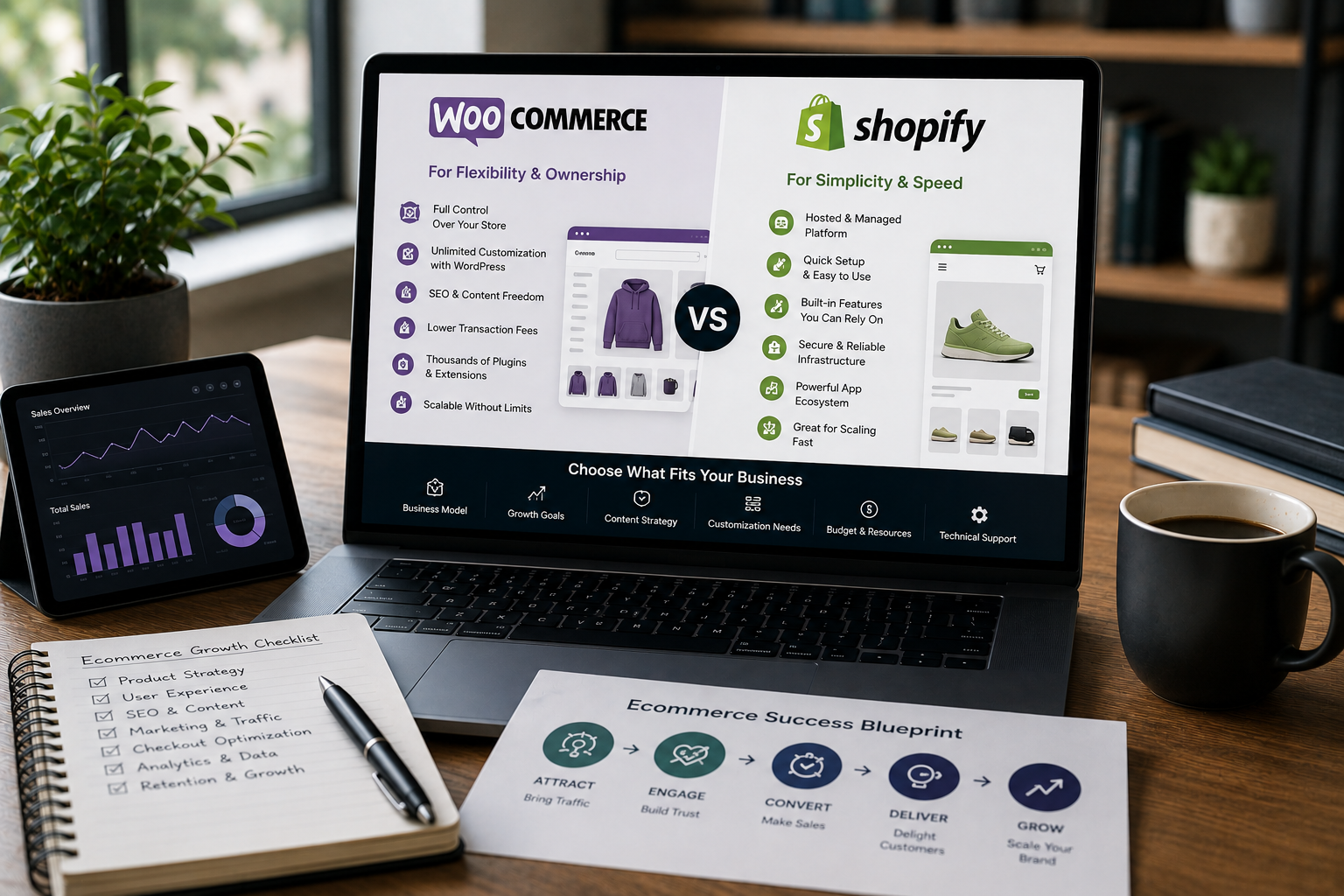
The easiest way to compare them is this: Shopify is managed and streamlined. WooCommerce is flexible and ownership-focused. Shopify gives you a ready ecommerce environment where many technical responsibilities are handled by the platform. You can focus on products, design, apps, orders, and marketing without managing hosting or WordPress plugin maintenance. WooCommerce gives you more control because it runs inside WordPress. You can shape the website structure, content system, product templates, SEO setup, checkout behavior, and backend workflows more deeply. For growing ecommerce brands, the question is not “Which one is popular?” The question is: Which one supports the way your business will grow?
Shopify: Strong for Simpler Operations
Shopify is often a strong choice for ecommerce brands that want to move fast and keep platform management simple. It works well when the business needs:
- A hosted ecommerce system
- Product and collection management
- Stable checkout foundation
- Payment and shipping setup
- App-based feature expansion
- Clean store admin experience
- Less technical maintenance
- A faster launch path For many product-based brands, this is enough to start and grow. A founder launching a direct-to-consumer product line may not want to manage hosting, plugin conflicts, backups, and WordPress updates. Shopify removes many of those concerns. That does not mean Shopify has no complexity. As the brand grows, customization, app dependency, SEO structure, and theme limitations can become important. But for store owners who want an ecommerce-first platform, Shopify is often easier to operate.
WooCommerce: Strong for Ownership and Flexibility
WooCommerce is often a strong choice when the store needs more control. Because WooCommerce runs on WordPress, it works well for businesses that need ecommerce plus a deeper website structure. For example, a brand may need:
- Product pages
- Blog content
- Buying guides
- Service pages
- Custom landing pages
- Resource libraries
- Case studies
- SEO category pages
- Custom checkout fields
- Custom product data
- Membership or gated content
- Integration with existing WordPress workflows WooCommerce gives more freedom to shape the store around the business. The tradeoff is maintenance. WooCommerce requires more care with hosting, updates, plugins, backups, security, speed, and compatibility. For a growing brand that wants ownership and custom workflows, that extra responsibility may be worth it. For a team that wants fewer technical decisions, it may become a burden.
Ownership and Control
Ownership is one of the biggest differences between Shopify and WooCommerce. With Shopify, your store runs inside Shopify’s platform. You manage products, content, customers, orders, themes, apps, and settings, but the core platform is controlled by Shopify. With WooCommerce, your store runs on your own WordPress setup and hosting. You control the files, database, theme, plugins, hosting environment, and broader website structure.
When Shopify Ownership Is Enough
Shopify ownership is usually enough when your store needs standard ecommerce operations and you are comfortable working inside a managed platform. This is suitable for brands that prioritize:
- Simpler management
- Platform stability
- Fast setup
- App-based features
- Standard checkout flow
- Less technical responsibility
When WooCommerce Ownership Matters
WooCommerce ownership matters when your business needs deeper control over the website and ecommerce structure. This may include:
- Custom product templates
- Advanced SEO content architecture
- Special checkout workflows
- Custom fields and post types
- More control over data handling
- Custom integrations
- WordPress-based publishing systems If ecommerce is only one part of a larger content or service website, WooCommerce may fit better.
Customization and Design Freedom
Both Shopify and WooCommerce can support good design. The difference is how customization happens. Shopify customization usually happens through themes, theme sections, apps, and Shopify development. Many changes can be made visually through the theme editor. Deeper changes require Liquid, Shopify theme knowledge, and careful app planning. WooCommerce customization happens through WordPress themes, plugins, templates, custom fields, and PHP or frontend development. It can be more open-ended, especially when the website needs a custom structure.
Shopify Customization Is Best When
Shopify works well when the store needs:
- Clean product pages
- Branded theme sections
- Custom homepage blocks
- Collection page improvements
- App-supported features
- Easier admin editing
- A polished ecommerce-first experience The main limitation is that some parts of Shopify are platform-controlled. Deep checkout or backend workflow changes may not always be possible in the way a business first imagines.
WooCommerce Customization Is Best When
WooCommerce works well when the store needs:
- Custom product logic
- Advanced content layouts
- Flexible SEO pages
- Custom checkout fields
- Service and product combinations
- Special pricing rules
- Custom backend workflows
- WordPress-based CMS control WooCommerce usually gives more development freedom, but that freedom should be managed carefully. Poorly planned customization can create performance and maintenance problems.
Apps vs Plugins
Shopify uses apps. WooCommerce uses WordPress plugins. Both ecosystems can extend your store with features like reviews, subscriptions, discounts, filters, analytics, email marketing, shipping rules, loyalty programs, and product options. The risk is dependency. Too many apps or plugins can create:
- Extra cost
- Slower loading
- Confusing settings
- Design inconsistency
- Compatibility issues
- Harder maintenance
- Data scattered across tools
Shopify App Planning
Shopify apps are often easy to install, but a growing brand should avoid adding apps without a clear reason. Before installing an app, ask:
- Is this feature essential?
- Does the theme already support it?
- Will the app slow the store?
- Does it match the brand design?
- Will it be needed long term?
- What happens if it is removed later?
WooCommerce Plugin Planning
WooCommerce plugins can be powerful, but they need technical care. Before adding a plugin, ask:
- Is it actively maintained?
- Does it affect checkout?
- Does it conflict with existing plugins?
- Does it add unnecessary scripts?
- Is the feature better built custom?
- Will it make future updates harder? A growing ecommerce store should not be built by stacking tools randomly. Each app or plugin should support a real business need.
SEO and Content Growth
SEO is one of the most important decision points for growing ecommerce brands. Both Shopify and WooCommerce can support SEO, but they give different levels of control. Shopify supports SEO basics like product titles, meta descriptions, image alt text, redirects, collection pages, blogs, and clean store navigation. For many brands, this is enough when the site is planned well. WooCommerce sits inside WordPress, which gives more flexibility for content-heavy SEO strategies. This is useful for brands that want to build resource hubs, buying guides, comparison content, service pages, custom category content, and advanced internal linking.
Choose Shopify for SEO When
Shopify can be a good SEO fit when:
- The store has a clear product catalog
- Collection pages are planned properly
- Product descriptions are useful
- Metadata is written carefully
- Blog content is enough for the strategy
- The theme is fast and clean
Choose WooCommerce for SEO When
WooCommerce may be better when:
- Content is central to growth
- The site needs many custom landing pages
- The business needs detailed blog or guide structures
- SEO templates need deeper control
- Internal linking needs more flexibility
- Products are part of a larger content ecosystem SEO should not be treated as a task after launch. Platform choice affects how content can be structured.
Checkout and Conversion Experience
Checkout matters because it is where interest becomes revenue. Shopify provides a managed checkout experience that is often easier for store owners to rely on. For many brands, this is a major advantage. It keeps checkout clean, familiar, and platform-supported. WooCommerce checkout can also work very well, but it depends more on hosting, theme quality, plugin setup, payment gateway configuration, and custom development.
Shopify Checkout Strength
Shopify is usually strong when the store needs:
- Standard ecommerce checkout
- Stable payment flow
- Simple shipping and discount rules
- Fewer technical checkout responsibilities
- Platform-managed checkout experience
WooCommerce Checkout Strength
WooCommerce can be stronger when the store needs:
- Custom checkout fields
- Service-based checkout
- B2B order workflows
- Quote-based buying
- Product-specific rules
- Custom payment conditions
- More control over checkout behavior For growing brands, checkout decisions should be made early. It is risky to design a custom buying flow without confirming what the platform can support.
Maintenance and Team Workflow
Maintenance is where the two platforms feel very different. Shopify reduces technical maintenance because hosting, platform updates, and core infrastructure are handled by Shopify. Your team still needs to manage products, apps, content, theme changes, analytics, and orders, but the technical foundation is more controlled. WooCommerce needs more active maintenance because it depends on WordPress, hosting, plugins, themes, updates, backups, and security.
Shopify Is Better When
Shopify is often better when:
- The team wants less technical responsibility
- Ecommerce operations are the main focus
- The store does not need deep backend customization
- The team wants a simpler admin experience
- The business prefers platform-managed infrastructure
WooCommerce Is Better When
WooCommerce is often better when:
- The team already uses WordPress
- The business needs flexible content management
- Custom workflows are important
- There is technical support available
- The brand values ownership and control The right choice depends partly on who will manage the store after launch.
Cost and Long-Term Planning
Cost is not only the platform fee. For Shopify, costs may include platform subscription, apps, premium themes, payment processing, and development support. For WooCommerce, costs may include hosting, premium plugins, theme development, security tools, maintenance, backups, performance optimization, and development support. The better question is not “Which one is cheaper?” The better question is: Which platform gives the best value for the way the store needs to operate? A simple Shopify store may be easier to budget. A custom WooCommerce store may offer more flexibility but require more technical investment. A heavily app-dependent Shopify store can become expensive over time. A poorly maintained WooCommerce store can become costly to fix. Cost should be evaluated over time, not only at launch.
Decision Checklist for Growing Brands
Choose Shopify if:
- You want simpler platform management
- You want an ecommerce-first admin
- Your store has standard product and checkout needs
- You prefer apps for extra features
- You want less responsibility for hosting and updates
- Your team wants a cleaner day-to-day workflow
- You can work within Shopify’s platform rules Choose WooCommerce if:
- You want more ownership and control
- You need strong WordPress content features
- You need custom workflows
- SEO content architecture is central to growth
- You need more checkout flexibility
- You already have technical support
- Your website is more than only a product store
Common Mistakes to Avoid
Choosing Only Based on Launch Speed
Fast launch is useful, but the platform should also support future changes.
Ignoring SEO Structure
SEO should be planned before choosing templates, collections, categories, and URLs.
Adding Too Many Apps or Plugins
Every extension adds cost, complexity, and maintenance responsibility.
Assuming Checkout Can Do Anything
Checkout customization is platform-dependent. Always confirm before planning advanced flows.
Underestimating Store Management
The platform should match the team’s ability to manage products, content, orders, updates, and improvements.
Need Help Choosing or Building the Right Store?
If you are planning a growing ecommerce brand, the platform decision should match your business model, content strategy, checkout needs, design goals, SEO requirements, and operational workflow. Through Shopify Development, I can help plan and build a Shopify store with cleaner theme structure, better product pages, custom sections, app planning, SEO foundations, and a stronger ecommerce experience. The goal is not just to launch a store. The goal is to build a store that can support growth without becoming difficult to manage.
Final Recommendation
Shopify and WooCommerce are both strong platforms. Shopify is often better for brands that want simpler operations, hosted ecommerce, app-based features, and less technical maintenance. WooCommerce is often better for brands that want ownership, WordPress flexibility, custom workflows, and deeper content control. Before choosing, write down:
- What products you sell
- How complex your catalog is
- How important SEO is
- What checkout rules you need
- What content the website needs
- Which integrations matter
- Who will manage the store
- What custom features may be needed later That list will usually make the platform choice clearer. A growing ecommerce brand should not choose based only on what is easiest today. It should choose based on what will still make sense as the store becomes more serious.
FAQ
Is Shopify or WooCommerce better for growing ecommerce brands?
Shopify is often better for brands that want simpler platform management and a hosted ecommerce setup. WooCommerce is often better for brands that want more ownership, WordPress content control, and deeper customization. The better choice depends on how the business plans to grow, not only on the platform name.
Which platform is easier to manage, Shopify or WooCommerce?
Shopify is usually easier to manage because hosting, core updates, and platform maintenance are handled inside Shopify. WooCommerce needs more active maintenance because it runs on WordPress with hosting, themes, and plugins. This makes Shopify attractive for teams that want fewer technical responsibilities.
Which is better for SEO, Shopify or WooCommerce?
Both can support SEO, but WooCommerce gives more content and technical control through WordPress. Shopify can still perform well when product pages, collections, metadata, internal links, and content are planned properly. If your growth depends heavily on content marketing and custom SEO structures, WooCommerce may offer more flexibility.
When should a brand choose Shopify?
A brand should choose Shopify when it wants a managed ecommerce platform, cleaner day-to-day operations, reliable product management, app-based features, and less technical responsibility. Shopify is especially useful when the store has standard ecommerce needs and the team wants to focus more on products and marketing.
When should a brand choose WooCommerce?
A brand should choose WooCommerce when it needs more control over content, SEO structure, custom workflows, backend flexibility, checkout logic, or WordPress-based website architecture. WooCommerce is often a better fit when ecommerce is part of a larger content-rich website.
Can a store migrate from WooCommerce to Shopify later?
Yes, migration is possible, but it should be planned carefully because products, customers, orders, URLs, SEO metadata, redirects, content, and integrations may need structured handling. A rushed migration can create SEO issues, broken URLs, missing data, or customer experience problems.